In the entire process of injection molding processing, injection molds are far from being simple “tools”; they serve as the core hub throughout “design concept – raw material melting – finished product forming.” From a single plastic pellet to a precision part, and from single-piece trial production to mass production in the millions, the design, precision, and performance of injection molds directly determine whether injection molding processing can be achieved, whether product quality meets standards, and whether production efficiency can be improved. It can be said that without a properly matched injection mold, even the most advanced injection molding machines and the highest-quality raw materials cannot be transformed into qualified products. This article will systematically analyze the key roles of injection molds in injection molding processing from four dimensions: forming foundation, quality control, efficiency guarantee, and process innovation.
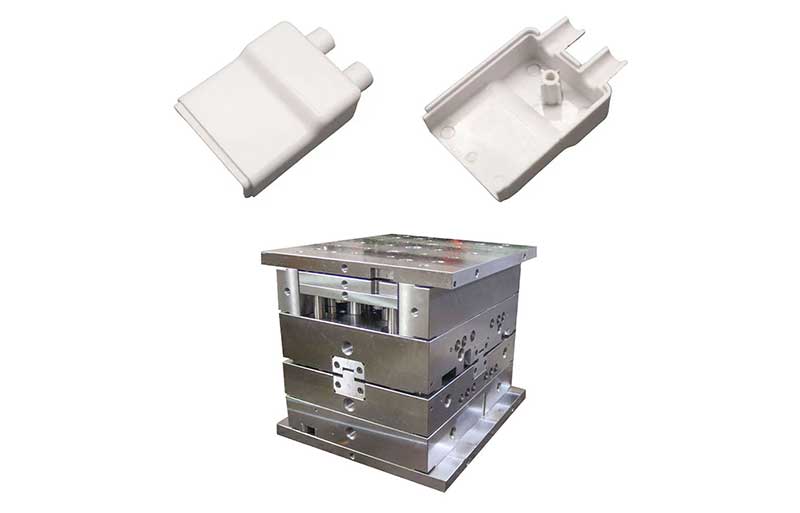
I. The “Basic Carrier” of Forming: Defining Product Shape and Structure
The essence of injection molding processing is to “inject molten plastic into the mold cavity and replicate the cavity’s shape after cooling,” and the injection mold is the sole carrier for achieving this process. It endows plastic with specific shapes, dimensions, and functions, acting as a bridge between “design drawings” and “physical products.”
1. Cavity: The “Replication Template” for Product Shapes
The core component of a mold is the “cavity,” whose internal contour is precisely machined according to the product design drawings. Whether it’s the plug groove of a mobile phone charger or the curved surface of a car bumper, all need to be accurately presented through the cavity. For example, when producing toy parts with snaps and threads, the mold cavity is pre-machined with corresponding snap protrusions and thread patterns. After the molten plastic fills the cavity and cools and solidifies, it forms a structure identical to the cavity, eliminating the need for subsequent cutting or assembly.
For complex products (such as laptop touchpad brackets), the cavity also needs to integrate multiple functional structures, including locating pins, heat dissipation holes, and conductive contacts, to achieve “one-step forming.” Without the cavity design of the mold, such parts would require multiple processing steps, which would not only be inefficient but also affect performance due to assembly errors.
2. Parting Surface and Gating System: Guiding Plastic Flow and Forming
The parting surface (the joint surface between the fixed mold and the moving mold) and the gating system (main runner, sub-runners, and gates) of an injection mold are crucial for ensuring the smooth filling of the cavity with plastic.
- Parting Surface: It determines the mold opening and closing direction and the product demolding path. For example, when producing hollow plastic bottles, the parting surface should be designed along the centerline of the bottle body to ensure that the bottle can be easily removed after the mold opens. Improper parting surface design may lead to flash on the product or difficulty in demolding.
- Gating System: It acts as the “conveying pipeline” for plastic. The main runner connects to the injection molding machine’s nozzle, the sub-runners distribute the plastic to multiple cavities (in multi-cavity molds), and the gates control the speed and position of plastic entering the cavity. For example, in a 32-cavity mold for beverage bottle caps, the sub-runners need to be evenly distributed to ensure consistent filling speed in each cavity, avoiding underfilling in some caps and overflow in others.
II. The “Direct Controller” of Quality: Determining Product Precision and Stability
More than 80% of the quality of injection-molded parts (dimensional accuracy, surface quality, and mechanical properties) is determined by the injection mold. The mold’s precision, cooling system, venting system, and other designs directly affect the flow, cooling, and solidification processes of plastic in the cavity, resulting in different quality outcomes.
1. Precision Control: Locking in Product Dimensional Tolerances
The machining precision of the mold is directly transferred to the product. Dimensional deviations in the cavity will be reflected 1:1 in the injection-molded parts, so extremely high precision is required for molds used in precision products. For example, in the production of 5G connector molds, the dimensional tolerance of the cavity needs to be controlled within ±0.005mm to ensure that the pin spacing (0.5mm) of the connector has a tolerance of ≤±0.01mm, meeting the stability requirements for signal transmission. If there is a 0.01mm deviation in the mold cavity, the finished product will be incompatible with other components due to dimensional out-of-tolerance.
In addition, the precision of the mold’s guiding mechanism (guide pins and guide sleeves) is also crucial. The clearance between them needs to be ≤0.003mm to ensure precise alignment of the cavity and core during mold closing, avoiding uneven wall thickness in the product (a deviation exceeding 0.1mm will affect mechanical strength) due to misalignment.
2. Cooling System: Ensuring Stable Product Forming
After plastic is injected into the cavity, it needs to be rapidly and uniformly cooled by the mold’s cooling system to solidify and set. The design of the cooling system directly affects the shrinkage rate, warpage, and surface quality of the product.
- If the cooling water channels are close to the cavity and evenly distributed (e.g., the water channel distance from the cavity is 8-10mm for PC transparent part molds), the plastic cools at a consistent speed, resulting in a finished product with no shrink marks or warpage.
- If the cooling water channel design is unreasonable (e.g., no contour water channels for thick-walled parts), uneven cooling can occur, with some areas cooling too fast or too slow, leading to warpage (a deformation exceeding 0.5mm will result in scrap) or internal stress cracking in the product.
For example, in the production of car dashboard molds, dense water channels need to be added in the thick-walled areas (such as edge reinforcing ribs) of the dashboard to avoid surface depressions caused by uneven cooling, which would affect appearance and assembly.
3. Venting System: Eliminating Hidden Defects in Products
When plastic fills the cavity, if the air inside the cavity and the gases volatilized from the plastic cannot be vented, bubbles or scorch marks (high-temperature compressed air igniting the plastic) may form on the surface of the finished product, or local underfilling (short shots) may occur. The venting slots (usually located at the last filling point of the melt, with a depth of 0.01-0.03mm) in the injection mold are the key to solving this problem.
When producing thin-walled connectors (with a wall thickness of 0.3mm), the venting slots need to be precisely located at the corners of the cavity to ensure timely venting of air and avoid bubbles in the finished product. If the venting slots are blocked or not designed, the defect rate can soar to over 30%, requiring mold cleaning and significantly affecting production continuity.
III. The “Core Guarantor” of Efficiency: Shortening Cycles and Increasing Capacity
The efficiency of injection molding processing (output per unit time, equipment utilization rate) largely depends on the design optimization of the mold. A reasonably structured mold can shorten the forming cycle and reduce downtime, directly improving overall production capacity.
1. Multi-Cavity Design: Multiplying Mass Production Capacity
The number of cavities in a mold determines the number of products formed in a single injection. Multi-cavity molds are the core means of achieving “efficient mass production.” For example, when producing beverage bottle caps, using a 32-cavity mold can produce 32 caps in a single injection. Coupled with a high-speed injection molding machine (with a cycle time of 3 seconds per injection), the hourly production capacity can reach 38,400 caps, and the daily production capacity can exceed 900,000 caps. If a single-cavity mold is used, the production capacity is only 1/32 of that of a multi-cavity mold, which cannot meet market demand at all.
The key to multi-cavity molds lies in the “uniformity of sub-runners.” Mold flow analysis (Moldflow) is required to optimize the dimensions of sub-runners to ensure consistent filling speed and pressure in each cavity, avoiding underfilling in some cavities and overflow in others, and ensuring uniform product quality across multiple cavities.
2. Cooling and Demolding Design: Shortening the Forming Cycle
The cooling time accounts for 60%-80% of the forming cycle, and the design of the mold’s cooling system directly determines the cooling efficiency.
- Using 3D-printed contour cooling water channels (which completely conform to the cavity’s curved surface) can reduce the cooling time by 20%-30% compared to traditional straight water channels. For example, when producing a 2mm-thick ABS home appliance housing, traditional water channels require 25 seconds of cooling, while contour water channels only need 18 seconds, shortening the cycle per part by 7 seconds and increasing daily production capacity by 30%.
- At the same time, the design of the mold’s demolding mechanism (ejector pins, ejector plates, and lifters) also affects efficiency. If the demolding mechanism moves smoothly and positions accurately, “second-level demolding” can be achieved, avoiding parts getting stuck in the cavity and causing downtime. Conversely, if the lifter jams, each downtime for cleaning can take more than 30 minutes, seriously dragging down production capacity.
3. Mold Life: Ensuring Continuous Production Stability
The service life of a mold (the number of moldings it can produce) determines the continuous operation capability of the production line. High-quality molds (made of quenched steel H13, for example) can have a service life of over 1 million moldings, without the need for frequent repairs during this period. On the other hand, low-quality molds (made of ordinary steel without heat treatment) may show cavity wear and ejector pin breakage after only 100,000 moldings, requiring downtime for repairs (each repair takes 1-2 days), resulting in production capacity losses.
For example, a certain automotive parts factory uses a 718H steel mold to produce bumper brackets, with an average of only 2 repairs per year. Previously, when using ordinary steel molds, there were more than 10 repairs per year, and downtime losses accounted for 15% of the total production capacity. It is evident that durable molds are the foundation for ensuring continuous and efficient injection molding processing.
IV. The “Driver” of Process Innovation: Expanding the Boundaries of Injection Molding Processing
Many advanced injection molding processes (such as multi-material molding, precision micro-molding, and in-mold decoration) rely entirely on breakthroughs in mold technology. Structural innovations in molds directly expand the application scope of injection molding processing, enabling the production of “more complex, more functional, and higher value-added” products.
1. Two-Color/Multi-Color Molds: Achieving Integrated Multi-Material Molding
Traditional injection molding can only process a single material, while two-color molds, through designs such as “rotating cavities” or “moving mold plates,” can integrate two different materials (such as hard plastic ABS + soft plastic TPE) in a single molding. For example, when producing toothbrush handles, a two-color mold first injects hard plastic ABS to form the handle body and then rotates the cavity to inject soft plastic TPE to form anti-slip grip patterns, eliminating the need for subsequent bonding, improving efficiency by 40%, and achieving higher bonding strength (less likely to detach).
Without two-color molds, such multi-material products would require two separate injection moldings and manual assembly, which would not only be costly but also prone to assembly gaps.
2. Insert Molds: Integrating Metal and Plastic Functions
Insert molds integrate metal inserts (such as nuts and electrodes) into the cavity in advance. During injection molding, the plastic and metal are tightly combined, achieving functional integration of “plastic + metal.” For example, when producing home appliance brackets, an insert mold embeds metal nuts into the plastic bracket, avoiding the need for subsequent drilling and tapping, improving precision (nut position tolerance ≤±0.02mm) and reducing processes.
This process is widely used in the automotive and electronics fields, such as automotive sensor housings (plastic + metal pins) and mobile phone charging ports (plastic + metal contacts), all relying on insert molds for functional integration.
3. In-Mold Decoration Molds (IMD/IML): Enhancing Product Value-Added
In-mold decoration molds place a printed film in the cavity, and during injection molding, the plastic and the film are molded together, directly forming patterns and textures (such as gradient colors and brushed finishes) on the product surface, eliminating the need for subsequent screen printing or film application. For example, home appliance panels formed using IMD molds have wear-resistant and non-fading surface patterns, with a value-added of over 20% compared to traditional screen-printed products.
Without in-mold decoration molds, such high-appearance-requirement products would require multiple processes, and the patterns would be prone to wear, unable to meet high-end market demands.
V. The “Implicit Regulator” of Cost: Optimizing Full-Cycle Costs
The design and selection of injection molds also indirectly affect the full-cycle costs of injection molding processing. Reasonable mold design can reduce waste and lower maintenance costs, while extending mold life can spread out unit costs.
For example, hot runner molds keep the plastic in the runners molten through heating, resulting in no runner waste (waste rate ≤2%). Compared to cold runner molds (with a waste rate of 8%-12%), a bottle cap project producing 1 million pieces per year can save over 150,000 yuan in raw material costs. Another example is molds with insert structures (where locally worn parts can be replaced individually). Replacing a worn cavity insert takes only 2 hours and costs 500 yuan, while replacing the entire cavity in an integral mold takes 2 days and costs over 5,000 yuan.
Conclusion
The role of injection molds in injection molding processing has long surpassed the scope of being a mere “forming tool.” They are the “definers” of product shapes, the “controllers” of quality, the “guarantors” of efficiency, the “drivers” of innovation, and the “regulators” of costs. From everyday plastic bottle caps to precision automotive sensors, from simple toy parts to complex 5G connectors, the birth of every injection-molded product is inseparable from the precise赋能 (this Chinese term is better replaced with “empowerment” in English) provided by molds.
With the development of intelligent manufacturing, injection molds are evolving towards “intelligent molds” (embedded with sensors to monitor temperature and pressure in real-time) and “rapid prototyping molds” (3D-printed molds to shorten development cycles). However, their core role – connecting design and production and ensuring quality and efficiency – remains unchanged. For injection molding processing enterprises, paying attention to the design, manufacturing, and maintenance of molds is equivalent to grasping the “core lifeline” of injection molding production and is also the key to enhancing product competitiveness.