
In modern manufacturing, injection molding has become the preferred process for mass production of plastic parts due to its high efficiency, precision, and automation. However, as product functions and usage requirements continue to evolve, a single plastic structure can no longer meet the demands for multiple properties such as strength, rigidity, wear resistance, or heat resistance. Insert molding has emerged as a solution, enabling the integration of metal, fiber, or other prefabricated parts with plastic during the injection molding process. This not only significantly enhances the overall performance of the product but also streamlines subsequent assembly processes and reduces manufacturing costs.
1. What is Insert Molding?
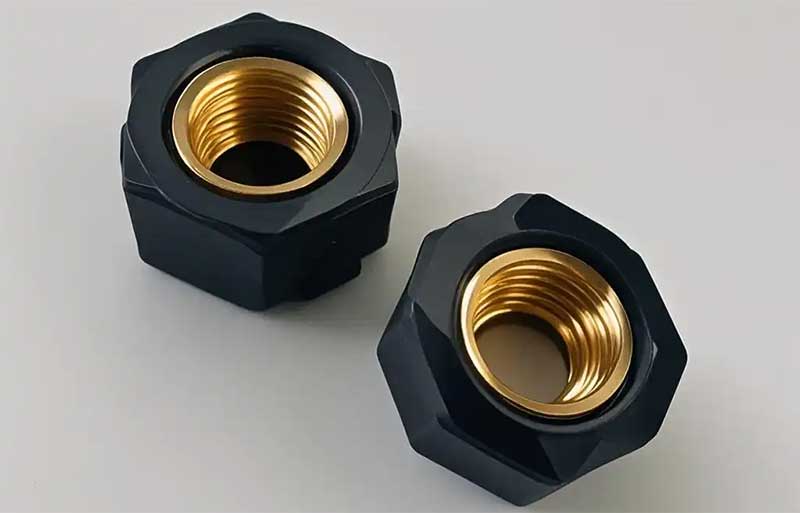
Insert molding is an integrated molding process in which inserts (typically metal nuts, copper sleeves, neodymium iron boron magnets, electronic components, etc.) are pre-placed in an injection mold. After the molten plastic is injected and cools and solidifies, the inserts are firmly bonded to the plastic. Compared to traditional post-assembly methods, insert molding can integrate metal and plastic in a single injection cycle, creating composite parts that feature both metal threads, clamping structures, or conductive paths, as well as plastic encapsulation, insulation, or protective functions.
2. Common Types of Inserts
Threaded Inserts
These are most commonly used to create durable metal threaded holes in plastic parts that can accommodate repeated screw installations. They come in two structural types: through-hole and blind-hole. The former has openings at both ends, while the latter is closed at one end, allowing selection based on design requirements.
Metal Bushings and Rings
Used to reinforce areas requiring metal wear surfaces, such as bearing seats or hinges, and are commonly found in consumer electronics and automotive interiors.
Electronic Component Inserts
Components like LEDs, sensor probes, and coils can be integrated through insert molding to achieve chip-level packaging or functional integration.
Structural and Decorative Inserts
Metal plates, fiber-reinforced parts, hardware components, etc., can be used to provide plastic parts with higher strength or special surface effects through insert molding.
3. Process Flow and Key Steps
Insert Preparation
Based on the part design requirements, inserts undergo degreasing, rust prevention, and preheating treatments to ensure cleanliness and temperature compatibility with the molten plastic. This prevents poor adhesion or reduced plastic flowability due to excessive temperature differences.
Mold Design and Assembly
The mold must incorporate dedicated insert positioning holes or fixtures in the cavity or core, along with spring, snap-fit, or magnetic retention mechanisms to ensure the inserts remain accurately positioned without shifting during injection.
Insert Loading
- Manual Loading: Suitable for small-batch production or complex inserts when manual placement costs are acceptable.
- Automated Loading: Utilizes vibratory feeders, manipulators, or robots for efficient and precise loading in high-volume production, reducing human errors.
Injection Molding
During the standard injection cycle phases—plasticization, injection, packing, and cooling—the molten plastic is injected under high pressure into the cavity, encapsulating or tightly bonding with the inserts. Strict control of injection pressure and packing profiles is essential to prevent insert displacement and flash formation.
Mold Opening and Part Ejection
After cooling and solidification, the mold opens, and an ejector system pushes out the finished part with the inserts, eliminating the need for subsequent assembly steps.
Post-Processing and Inspection
The finished parts undergo flash trimming, visual inspection, and torque testing to ensure the insert’s locking performance and positional accuracy meet design specifications.
4. Design Guidelines and Considerations
Insert Positioning Accuracy
Inserts must be accurately positioned in the mold’s clamping surface and cavity. It is recommended to design positioning slots and stop structures on the insert’s outer diameter or base plate to prevent displacement caused by injection pressure.
Thickness and Clearance
An appropriate surrounding plastic wall thickness (generally ≥0.5 mm) must be maintained between the insert and plastic to ensure proper plastic flow and bonding strength, preventing weld line cracking or insert loosening due to thin walls.
Injection Parameter Optimization
Based on the insert’s heat capacity and thermal conductivity, optimize mold and injection temperatures to prevent demolding issues caused by excessive heat or poor fusion due to insufficient heat.
Material Compatibility
The plastic material must be compatible with the insert’s surface. For metal inserts, chemical plating or sandblasting can be considered to increase surface roughness, enhancing mechanical interlocking and chemical adhesion.
Venting and Cooling Design
Adequate venting channels are required around the insert area to avoid air bubbles. Additionally, cooling water lines should be strategically placed to ensure simultaneous and appropriate cooling rates for the insert and plastic, preventing warping and stress concentration.
5. Process Advantages
High Strength and Durability
Metal inserts act as a “skeleton” within the plastic part, significantly improving torque, tensile, and shear properties, and extending product lifespan.
Simplified Assembly Process
One-step molding eliminates the need for subsequent processes such as nut insertion, gluing, or welding, reducing labor costs and defect rates.
Enhanced Structural Reliability
Inserts and plastic achieve molecular bonding in the molten state, preventing loosening due to vibration or thermal cycling, which can occur with post-assembly methods, thus eliminating failure risks.
Rich Functional Integration
Conductive, thermal conductive, positioning, and connection functions can be integrated into plastic parts, achieving organic fusion between plastic and metal.
6. Typical Application Cases
- Consumer Electronics: Integrated molding of mobile phone back covers and camera modules with embedded metal threads and antenna structures.
- Automotive Components: Critical load-bearing parts such as instrument panel mounting posts and air conditioning vent shafts.
- Home Appliances: One-piece molding of washing machine faucet connectors and valve bodies for high-pressure sealing.
- Medical Devices: Adding metal needle seats to syringe needles to ensure safety and precision during use.
- Tool Handles: One-step molding of threaded inserts and plastic handles to improve grip strength and durability.
7. Challenges and Future Trends
Automation and Intelligence
With the advancement of Industry 4.0, insert loading, mold temperature control, and process monitoring are transitioning toward full automation, enabling real-time data collection and fault prevention.
Composite Materials and Green Manufacturing
In the future, there will be increased adoption of bio-based resins and biodegradable inserts, as well as 3D printing rapid prototyping technology, seamlessly integrating with traditional injection molding to shorten product development cycles and reduce environmental impact.
High Precision and Miniaturization
Micro-insert molding is gradually maturing, enabling the combination of micron-scale inserts with plastic structures for applications in microsensors and medical microdevices.
Insert molding, with its advantages of integrated molding, high reliability, and multifunctional integration, is becoming a crucial method for high-end plastic part manufacturing. Mastering insert design, mold manufacturing, and process optimization can help companies quickly respond to market demands, enhancing product competitiveness and added value. In the future, with the widespread adoption of automation, intelligence, and green materials, the insert molding process will undoubtedly thrive in more fields, driving continuous innovation and development in the manufacturing industry.