
In injection molding processing, flow marks are a common cosmetic defect. They not only affect the appearance of products but may also indicate issues with material properties or process parameters. In severe cases, they can even weaken the structural strength of products. For industries pursuing high quality, such as electronics, medical, and automotive, the appearance of flow marks can lead to the rejection of entire batches of products, resulting in significant economic losses. This article will provide a detailed explanation of the definition, causes, and systematic solutions of flow marks to help enterprises effectively avoid this problem.
I. What Are Flow Marks?
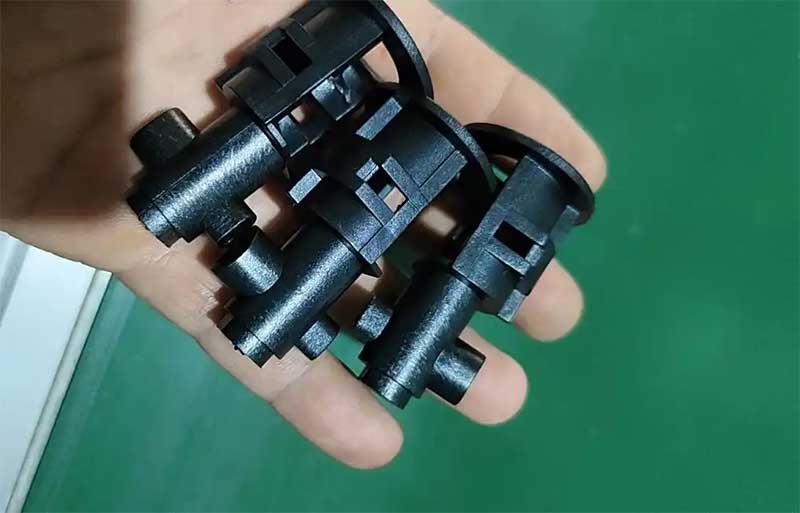
Flow marks (also known as “silver streaks” or “water streaks”) refer to white, silver, or transparent streaks, spots, or filamentous substances that appear on the surface or inside of injection-molded products. They come in various forms: some are distributed radially, some are diffused in a cloud-like manner, and some form long, thin streaks along the direction of material flow.
In terms of location, flow marks often appear near the gate, at areas with sudden changes in wall thickness, or in regions where the melt fills last (such as corners and deep cavities).
From the perspective of causes, flow marks are not defects of the material itself. Instead, they occur because gases, moisture, or impurities are mixed into the melt and cannot be discharged during the molding process. As a result, they remain in the product as bubbles or volatiles and form visible traces after cooling.
For example, on transparent PC lenses, flow marks appear as obvious “white fog”; on dark-colored ABS casings, they present as silver-white streaks, seriously affecting the visual effect of the products.
II. Common Causes of Flow Marks
The formation of flow marks is essentially due to the fact that “foreign substances (gases, moisture, impurities) in the melt cannot be effectively removed under the action of pressure or temperature.” The specific causes can be divided into the following categories:
1. Material Factors: Interference from Moisture and Impurities
- Raw Material Moisture Absorption: Moisture-absorbing plastics (such as PA, PC, and PBT) absorb moisture from the air during storage. When heated, the moisture evaporates into water vapor, which is mixed into the melt to form bubbles. After cooling, these bubbles become flow marks. For example, when the moisture content of PA66 exceeds 0.05%, gases will be produced due to hydrolysis during injection molding, resulting in silver streaks.
- Impurity Contamination: If the raw material is mixed with dust, metal shavings, plastic particles of different grades, or if the proportion of regrind is too high (exceeding 30%) and it is not filtered, these impurities will not be evenly dispersed in the melt and will disrupt its continuity, forming spot-like flow marks.
- Additive Issues: Color masterbatches, lubricants, and other additives may have poor compatibility with the base material or be added in excessive proportions (for example, when the proportion of lubricant exceeds 1%). At high temperatures, they are prone to volatilization, producing gases. When the color masterbatch is not evenly dispersed, local discolored flow marks will also form.
2. Process Parameters: Imbalance of Temperature and Pressure
- Excessive Barrel Temperature: When the temperature exceeds the thermal stability limit of the material (for example, when PC exceeds 320°C and ABS exceeds 250°C), the plastic will degrade and produce gases (such as HCl and styrene). These gases form micro-bubbles in the melt, which eventually appear as flow marks.
- Excessive Injection Speed: High-speed injection can cause the melt to generate severe shear in the runner or cavity and entrain air. At the same time, when the melt front comes into contact with the mold cavity, if it cools too quickly, a “cold凝 layer” (cold layer) will form. When the subsequent melt breaks through this cold layer, it will entrain air, forming streaky flow marks.
- Insufficient Holding Pressure: During the holding stage, if the holding pressure is not enough to compact the gases or volatiles in the cavity, bubbles will remain inside the product. Especially in the central area of thick-walled parts, “vacuum bubbles” similar to flow marks are likely to form due to insufficient holding pressure.
- Low Back Pressure: When the back pressure (plasticizing pressure) is insufficient (below 5 bar), the screw cannot fully expel the gases in the melt during its backward movement. These gases enter the cavity along with the melt, forming dispersed flow marks.
3. Mold Design: Defects in Runners and Venting
- Poor Venting: In enclosed areas of the mold cavity (such as corners and deep cavities) or at the positions where multiple melt streams converge (the locations of weld lines), if no venting slots are provided, or if the venting slots are blocked or have insufficient depth (less than 0.01 mm), the gases cannot be discharged and will be encapsulated by the melt, forming flow marks.
- Unreasonable Runner and Gate Design:
- If the runner cross-section is too small or suddenly changes in diameter, it will increase the flow resistance of the melt, causing turbulence and entraining air.
- If the gate position is inappropriate (for example, far from the thick-walled area) or the gate size is too small (less than 0.5 mm), it will cause the melt to undergo shear heating and produce degradation gases.
- If the temperature of the hot runner system is unstable and cold material from the nozzle enters the cavity, local flow marks will form.
- Low Mold Temperature: When the mold temperature is lower than the glass transition temperature of the material (for example, when the PC mold temperature is below 80°C), the melt cools rapidly upon contact with the cavity, and its viscosity increases sharply. As a result, gases are difficult to discharge and are likely to form silver streaks on the surface.
4. Equipment Problems: Plasticizing and Sealing Failures
- Screw and Barrel Wear: Excessive clearance (exceeding 0.3 mm) between the screw and the barrel can cause the melt to flow back during the plasticizing process and entrain air. At the same time, the metal shavings produced by wear can contaminate the melt, forming impurity-related flow marks.
- Poor Sealing of the Check Ring: If the check ring is worn or aged, the melt will flow back during the injection stage and entrain air. This phenomenon is more obvious during high-pressure injection.
- Poor Material Feed in the Hopper: If the hopper bottom forms an arch or the filter screen is blocked, the supply of raw material will be interrupted. When the screw idles, it will entrain air, which will enter the barrel along with the raw material and form bubbles.
III. Systematic Solutions for Flow Marks
To solve the problem of flow marks, it is necessary to start from three dimensions: “controlling foreign substances at the source,” “optimizing process parameters,” and “improving mold design,” and take targeted measures based on specific causes.
1. Material Pretreatment: Eliminating Moisture and Impurities
- Strictly Dry the Raw Material: Moisture-absorbing materials must be pre-dried. The specific parameters are as follows:
- PA6/PA66: Dry at 80 – 100°C for 4 – 6 hours, and control the moisture content below 0.02%.
- PC: Dry at 120 – 140°C for 6 – 8 hours, and keep the moisture content ≤ 0.005%.
- PBT: Dry at 120°C for 3 – 4 hours to avoid residual crystal water.
It is recommended to use a dehumidifying dryer (with a dew point ≤ -40°C) and regularly detect the moisture content of the raw material (for example, by the gravimetric method or the Karl Fischer titrator).
- Purify the Raw Material and Regrind:
- Store the raw material with a cover to avoid dust contamination. Remove metal impurities through a magnetic filter before feeding.
- The regrind should be crushed and then passed through an 80-mesh filter screen, and its proportion should not exceed 20%. It should be evenly mixed with new material before use.
- Optimize the Use of Additives:
- Choose color masterbatches with good compatibility with the base material (such as PC-specific color masterbatches), and control the addition proportion within 2% – 5%.
- The addition amount of lubricants (such as zinc stearate) should not exceed 0.5%, and they should be pre-mixed with the raw material in advance.
2. Process Parameter Adjustment: Balancing Temperature and Pressure
- Control the Barrel Temperature: Set a reasonable temperature range according to the material characteristics to avoid overheating and degradation:
- ABS: 200 – 240°C (avoid exceeding 250°C).
- PC: 280 – 310°C (avoid exceeding 320°C).
- PA66: 240 – 270°C (for glass-fiber-reinforced types, it can be increased to 280°C).
It is recommended to adopt segmented temperature control (the feed section temperature is slightly lower, and the metering section temperature is slightly higher) and observe the melt state by injecting it into the air (no bubbles and uniform color).
- Optimize the Injection Speed and Pressure:
- Adopt a “slow – fast – slow” segmented injection method: Use a low speed (30 – 50 mm/s) at the initial stage to avoid entraining air, a medium speed (50 – 80 mm/s) at the middle stage to fill the main runner, and a low speed (20 – 30 mm/s) at the final stage to fill the end of the cavity, reducing shear.
- Increase the back pressure to 5 – 10 bar (adjust according to the material: take a high value for moisture-absorbing materials such as PC and PA, and a low value for non-moisture-absorbing materials such as PP and PE) to enhance the gas exhaust effect of the melt. However, note that excessive back pressure will prolong the plasticizing time.
- Extend the Holding and Cooling Time:
- Set the holding pressure to 60% – 80% of the injection pressure and extend the holding time until the gate solidifies (for example, for thick-walled PC parts, the holding time is 30 – 60 seconds) to ensure that gases are compacted and discharged.
- Appropriately increase the mold temperature (for example, raise the PC mold temperature from 80°C to 100°C) to reduce the cooling speed of the melt and facilitate gas escape.
3. Mold and Equipment Optimization: Enhancing Venting and Sealing
- Improve Mold Venting:
- Open venting slots at the positions where the melt fills last (such as cavity corners and weld line positions). The depth is 0.01 – 0.02 mm (take a larger value for crystalline plastics and a smaller value for non-crystalline plastics), and the width is 5 – 10 mm.
- For multi-cavity molds, balance the runner lengths to ensure that each cavity is filled simultaneously and avoid gas retention due to filling time differences.
- Clean the venting slots in the mold to remove accumulated material or oil stains, and regularly check for blockages.
- Optimize Runners and Gates:
- Use a circular or trapezoidal cross-section for the runner, and set the diameter according to the size of the product (generally 6 – 12 mm). Avoid sudden diameter changes.
- Place the gate as close as possible to the thick-walled area and ensure that the gate size allows for smooth melt flow (for example, the gate diameter of ABS products is 1 – 2 mm). If necessary, use a fan-shaped gate to reduce shear.
- Regularly calibrate the temperature of the hot runner system to ensure that there is no cold material at the nozzle (the cold material well volume can be increased).
- Equipment Maintenance and Inspection:
- Regularly check the wear conditions of the screw, barrel, and check ring. Replace them in a timely manner when the clearance exceeds 0.2 mm.
- Clean the hopper and the feed inlet to ensure a smooth supply of raw material. Install a stirring device at the bottom of the hopper to prevent arch formation.
- Check the sealing of the hydraulic system to avoid fluctuations in injection pressure (the fluctuation range should be controlled within ± 2 bar).
4. On-Site Rapid Troubleshooting Methods
If flow marks suddenly appear during production, the following steps can be taken to quickly locate the cause:
- Observe the Position of the Flow Marks: Flow marks near the gate are often related to shear overheating or insufficient back pressure; flow marks in corners are usually caused by poor venting; and overall dispersed flow marks may be due to moisture absorption or degradation of the raw material.
- Check the State of the Raw Material: Take a small amount of raw material, dry it, and then conduct a trial molding. If the flow marks disappear, it indicates a moisture problem. Observe the state of the melt when it is injected into the air. If there are bubbles or discoloration, it indicates material degradation or impurity contamination.
- Adjust Key Parameters: First, increase the back pressure by 5 bar and extend the drying time. If it is ineffective, reduce the barrel temperature by 10 – 20°C, and then check whether the mold venting slots are blocked.
Conclusion
The key to solving the problem of flow marks lies in “prevention first and systematic troubleshooting.” By strictly controlling the quality of raw materials, optimizing process parameters, and improving mold venting design, the occurrence of flow marks can be fundamentally reduced. In actual production, it is recommended to use mold flow analysis software (such as Moldflow) to simulate the melt flow and gas distribution in advance and predict the risk of flow marks. At the same time, establish standardized procedures for raw material pretreatment and equipment maintenance to ensure the stability of each production batch. Only by controlling flow marks at the source can high-quality and low-cost production of injection-molded products be achieved.